Within many growing businesses, a persistent operational friction can exist between sustainability teams and marketing departments. Sustainability leads are eager to share authentic operational milestones, while marketing teams hesitate out of fear that unverified statements could trigger greenwashing allegations or public backlash Speaking on Sustainability Marketing Survival Conversations, Andrew Sheehan outlined how establishing radical transparency and rigorous verification mechanisms can eliminate this deadlock and build public trust. Personal accountability in comms To counter both greenwashing and greenhushing (going silent out of fear), communications must be rooted in personal accountability. On sustainabilityexamples.com, corporate claims cannot be posted anonymously under a generic brand logo: Signed transparency disclosures: before publishing, organisations sign a formal disclosure confirming that all shared data is true, fair, and complete to the best of their knowledge. Named individual attribution: every published case study is linked directly to a specific individual within the business. Attaching a real person to a claim deters exaggeration and encourages peer-to-peer knowledge sharing. Safe community environment: providing a platform focused on progress over perfection gives marketers the confidence to communicate transparently without fear of destructive attacks. "The best way to stop greenwashing is to hold people personally accountable," Andrew notes. "When an example goes out, everyone can see who within the organisation was behind the initiative". Third-party verification and AI storytelling To assist businesses in structuring precise, evidence-based copy, Andrew's team developed an AI storyteller that audits drafts for vague phrasing, prompting creators to supply specific metrics and percentages. The AI storytelling assistant scans narrative text to flag ambiguous claims and request precise data points. The team also practice direct supplier verification, where they reach out to third-party installers or vendors to confirm equipment deployment. This process also includes using documented evidence, where invoices, photographic proof, or certificates are checked before a blue-tick verification badge is issued. Through fact-checking and named accountability, organisations can move past defensive silence and communicate their environmental progress with total confidence.
“If it doesn’t bleed, it doesn’t read” was one of the challenges with the media that Andrew Sheehan cited in his interview on Sustainability Marketing Survival Conversations. Good news sustainability impact stories sadly don’t sell. Andrew, Founder and CEO of SustainabilityExamples.com , discovered that when corporate sustainability efforts remain trapped in internal silos or hidden behind expensive association paywalls, overall industry progress stalls. For many small and medium-sized enterprises (SMEs), finding proven environmental solutions traditionally required months of research, expensive memberships, or speculative boardroom guesswork. However, democratising access to real-world case studies could accelerate corporate sustainability and generate direct B2B revenue. Capturing organic demand Globally, the search phrase "sustainability examples" receives approximately 170,000 monthly searches from business leaders, investors, and consumers seeking practical solutions. By creating an open database of verified corporate initiatives, SustainabilityExamples.com connects companies directly with stakeholders searching for active solutions. Croke Park and food waste elimination A prime example of open discovery in action involves Croke Park, Ireland's largest stadium. Seeking to enhance their environmental performance, stadium managers used SustainabilityExamples.com to explore verified vendor solutions. Through the platform, Croke Park discovered Food Site (formerly Positive Carbon), a technology firm specialising in commercial food waste tracking. Because food waste carries a massive carbon footprint, identifying a proven solution immediately shaped Croke Park's next major sustainability initiative, dramatically reducing internal research time and meeting overheads. "Corporate sustainability is a movement, and a movement needs collective knowledge sharing," Andrew emphasises. "When we make solutions visible and discoverable, companies can take action faster and in a safer way". Tracking Marketing KPIs for Sustainability ROI To ensure sustainability efforts deliver clear commercial value, marketers must measure tangible engagement metrics, which SustainabilityExamples.com is able to provide: Industry & department analytics: identifies specific sector leaders and decision-makers viewing corporate initiatives. B2B lead generation: captures direct inbound enquiries from prospective commercial partners. Referral Web Traffic: tracks qualified traffic directed back to the main company domain. Peer upvotes & social proof: measures community endorsement and brand goodwill across the industry. By sharing verified results openly, businesses turn their environmental initiatives into strong drivers of brand equity and commercial growth. This also leads to radical transparency, which we’ll explore in part three.
In corporate communications and business management, sustainability is often mistakenly viewed as a pure cost centre or an optional exercise in virtue signalling. However, framing environmental initiatives purely through a moral lens frequently fails to convince executive leadership teams. During an episode of the Sustainability Marketing Survival Conversations podcast, host Simon Badman spoke with Andrew Sheehan , Founder and CEO of sustainabilityexamples.com . Andrew's path into sustainability was unconventional. Beginning his career as a qualified accountant in Ireland, he developed a deep background in reporting, auditing, and compliance before pivoting into marketing. In 2021, while serving as Head of Marketing for an Irish professional services firm, the birth of his first daughter inspired him to take action. Inspired by UK-based groups using marketing capabilities for good, he decided to pitch a comprehensive corporate sustainability strategy to his leadership team. Selling sustainability as commercial gains to the C-Suite When Andrew initially brought the idea to his executive team, he was met with scepticism. Rather than appealing to ethics alone, he adjusted his strategy and pitched sustainability strictly on commercial gains: Tenders and revenue growth: positioned the organisation to win B2B tenders that mandate ESG criteria. Operational cost reduction: showed long-term financial returns from reduced resource usage and energy efficiency, such as solar panel installations. Brand capital and recruitment: demonstrated how a genuine sustainability narrative attracts top job seekers and builds brand distinction in an AI-driven market. Supply chain alignment: enhanced Scope 3 reporting credentials to become an attractive partner for larger corporate clients. "You need to ensure that within that pitch it complements why it is good for marketing, finance, or HR," Andrew explains. "Marketers are the ones who have to be very good influencers. Making it make commercial sense is how you win". By reframing sustainability as an engine for value creation and brand resilience, businesses can secure leadership buy-in and establish long-term competitive advantages. Overcoming the "Green Ghost" Phenomenon Even with your C-Suite on board and the successful execution of sustainability initiatives, marketers face severe discoverability hurdles. Mainstream media often ignores positive stories because they lack dramatic conflict, while social media algorithms quickly bury announcements. Andrew terms companies caught in this trap "green ghosts", which are businesses doing genuine work that get zero airtime or visibility. The problem sees a business’s corporate website only reaching existing stakeholders, earned media and PR reluctant to cover standard good news, and social media content lifespan dictated by algorithms, resulting in fleeting visibility without sustained ROI. In part two, we’ll discover how Andrew tackled this issue.
Faced with increasing regulatory scrutiny and the threat of public criticism, many organisations have responded by withholding their environmental communications entirely. This practice, known as greenhushing, presents severe risks to corporate reputation and industry progress. According to Lee Green , retreating into silence is an unhelpful response to regulatory pressure. Both greenwashing and greenhushing stem from the same root cause: fear. The cost of corporate silence When responsible organisations stop communicating their authentic progress, the public narrative becomes dominated by negative stories and bad actors. Consequently, overall consumer and stakeholder trust across the entire category declines. "The answer to 'don't overclaim' was never 'say nothing'. It's 'claim precisely'. Stick to the evidence. It's harder, but that's the job," says Lee. Sustainability as core risk management Rather than viewing environmental initiatives as optional marketing costs that can be trimmed during economic downturns, forward-looking businesses treat sustainability as an essential risk management tool. Supply chain continuity: Climate disruption, resource scarcity, and labour issues directly affect operational viability, making sustainability a matter of business survival. Shared industry frameworks: Organisations like Cascale enable collective action and standardised measurement, allowing businesses to address systemic supply chain challenges efficiently. Commercial protection: As regional regulations tighten across Europe, Asia, and North America, compliant supply chains remain commercially viable while unprepared competitors face market exclusion. By grounding sustainability efforts in verifiable data and communicating claims precisely, marketers can navigate regulatory requirements and build lasting stakeholder trust.
As regulators clamp down on exaggerated environmental claims, marketing and communications teams require practical methods to verify their messaging before publication. The responsibility no longer rests solely with consumer-facing brands; it extends throughout the global supply chain. In his work with Cascale and through the development of My Green Comms , Lee Green highlights an essential operational shift: brands are now legally accountable for the environmental claims they inherit from their suppliers and manufacturers. Supply chain claim accountability means that, for example, a consumer brand which repeats a claim of its supplier in an ad must provide verifiable data and certification. Early lessons from the My Green Claims benchmark To understand the prevalence of unsubstantiated claims, Lee initiated a global benchmark analysing live marketing copy across sectors including travel, automotive, mining, and fashion using a structured verification methodology. His results were quite alarming and show the extent of the challenge businesses are facing: 83 live claims evaluated: Drawn from company homepages, promotional materials, and ESG reports. 25 categorised as "do not publish": Over 30% of live claims failed basic credibility checks and posed immediate regulatory risk. 11 fully approved: Only a small minority of claims possessed adequate supporting evidence in their published form. SME vs multinational performance: Less than a 2% difference in average scores between small businesses and global corporations, demonstrating that claim drift affects organisations of all sizes. Four practical verification steps for marketing teams To protect against regulatory action and maintain credibility, Lee recommends that organisations adopt straightforward internal review habits: Conduct the non-comms staff test: Share proposed copy with colleagues outside marketing or legal, such as a receptionist or finance manager. Ask what they take away from the statement. Public enforcement is based on reader interpretation, not internal intent. Apply the 24-hour evidence rule: If supporting documentation or verification data cannot be produced within 24 hours (or within one click on digital channels), the claim is too broad to publish. Embed data leads in copywriting: Involve sustainability leads and data managers directly in the copy creation process rather than treating them as late-stage proofreaders. Avoid absolute language: Take caution with absolute terms like "100% recyclable" or "zero impact." A garment made from recycled polyester may still feature conventional zips, labels, or trims that invalidate absolute statements.
Building authentic trust requires far more than signing an online pledge or printing a green badge on a PDF brochure. To establish genuine credibility, organisations need clear editorial governance, transparent processes, and verifiable evidence behind every public statement. Following their initial work creating Green Claims Policies for construction clients, Charlie Martin and his team surveyed employees, customers, board members, and investors. While employees welcomed the structural clarity and customers appreciated the transparency, investors and board members viewed proactive claim governance as a critical ESG risk mitigation strategy. This insight sparked the creation of the Anti-Greenwash Charter . Inside the signatory pipeline Joining the Charter is not an open door for every corporate applicant. Organisations must undergo a structured three-stage validation framework: Stage 1 : Application Vetting: The Charter team reviews the applicant for a history of regulatory issues with bodies like the ASA or CMA. Bad actors seeking to use the Charter for cover are rejected and required to maintain a clean record for up to three years before reapplying. Stage 2 : Signatory Development Phase: Approved organisations execute three foundational tasks: Content Audit : A complete check of static and evergreen material against global standards (the UK CMA Green Claims Code, European EmpCo regulations, US Green Guides, or Australian ACCC guidelines). Policy Publication : Publicly releasing an internal Green Claims Policy that details editorial rules and escalation procedures. Staff Training : Educating key teams on identifying greenwash and enforcing policy governance in daily operations. Stage 3 : Campaign Review Period: Over an initial 12-month period, the Charter conducts periodic, retrospective audits of live marketing campaigns, checking the underlying evidence for every claim made. This rigorous framework ensures that signatories establish an audited, repeatable system for responsible communication.
In the world of corporate communications, marketing teams frequently view environmental regulation as a legal hurdle to clear or a penalty to avoid. However, treating sustainability purely through the lens of compliance misses a far more valuable commercial reality. During an episode of the Sustainability Marketing Survival Conversations podcast, host Simon Badman spoke with Charlie Martin , CEO of the Anti-Greenwash Charter and founder of truMRK . Having spent a decade running a marketing agency in the UK built environment and construction sectors, Charlie experienced a crisis of purpose before a transformational brief shifted his career trajectory. Trust as a Driver of Brand Value In early 2021, following the publication of the Competition and Markets Authority (CMA) Green Claims Code, two forward-thinking clients approached him not with anxiety about penalties, but with a desire to build stakeholder trust. It revealed a possible paradigm shift in communications and marketing, where instead of the fear of regulation leading to silence, opting to build trust as a driver of brand value leads to proactive sustainability disclosures. The Kryptonite to Greenhushing However, in an era dominated by greenhushing, where businesses mute their environmental messaging out of fear of public backlash or regulatory fines, shifting the conversation to trust changes everything. When sustainability communication is framed as a key driver of brand trust, corporate hesitation turns into proactive engagement. To quantify the commercial weight of trust, Charlie highlighted data from Echo Research in their 2025 UK Reputation Valuation Report, which shows that 29% of total market value across the FTSE 350 is now attributed to corporate reputation. This equates to a financial value of £730 billion and has seen a year-on-year growth of £11 billion. "If you are not communicating about sustainability, you are literally missing out on one of the most significant levers that you can pull to build trust with all of your stakeholders," Charlie notes. By viewing responsible messaging as a strategic asset rather than a regulatory chore, organisations can move past defensive silence and unlock long-term brand equity.
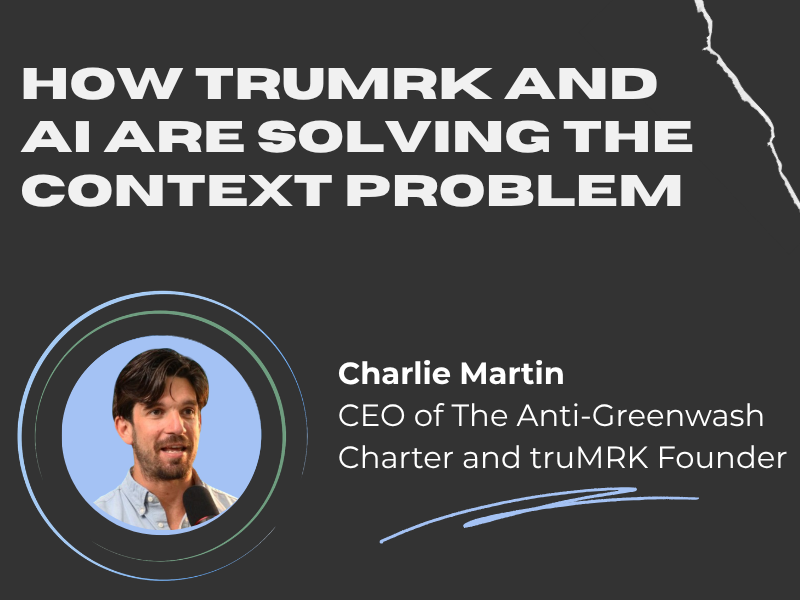
While retrospective audits ensure long-term accountability, they carry an inherent limitation: the campaign material has already been published to the public. If an environmental claim is misleading, checking it after the launch leaves the organisation vulnerable to reputational harm. To address feedback from Charter signatories wanting pre-publication protection, Charlie Martin founded truMRK , an AI-powered pre-publication engine, designed to evaluate marketing material before it goes live. The truMRK process A draft campaign goes through a staged process using truMRK: Claim substantiation and third-party evidence check Language alignment and regulatory compliance check Checking contextual readiness and analysis of omissions & framing If successful, production of a public transparency report & allocation of truMRK Badge. The Danger of Omission and Context The most innovative element of the truMRK system is its focus on contextual readiness: evaluating what a piece of content fails to say. Charlie points to high-profile regulatory action against HSBC as a classic example of contextual failure. When the bank launched a campaign highlighting renewable energy project investments, the claim was fully substantiated, and the language was legally compliant, but it was deemed misleading because HSBC omitted to disclose it had invested in fossil fuels during the same timeframe. The Mechanics of Public Verification When a campaign meets high-scoring thresholds across substantiation, regulatory language, and context, truMRK generates a detailed Transparency Report. The business can then append an interactive truMRK badge to the original content, giving readers direct access to independent verification. truMRK is built on three pillars: Substantiation - confirming all claims are backed by verified third-party evidence. Language alignment - ensuring terminology adheres strictly to regional regulatory frameworks. Contextual readiness - identifying critical operational omissions that could mislead readers. By establishing an open, verifiable standard for editorial excellence, truMRK aims to turn responsible comms into a universal social licence to operate, driving authentic corporate transformation from the outside in.
The higher education sector produces some of the most vital climate and environmental research in the world. From tracking glacial meltwater impacts on local communities to monitoring water scarcity levels, academic institutions house the raw insights required to navigate the climate transition. However, a significant barrier frequently stalls this progress: the language of academia is inherently insular. Specialised research papers are routinely dense with technical terminology, complex datasets, and niche methodologies that are completely inaccessible to the average person. For Sheanne Mulholland , the primary role of a media relations officer is to act as an active translator: stripping away academic jargon to unlock the human story hidden within the science. The David Attenborough Lesson To illustrate the vital need for simplicity in public relations, Simon Badman, in chatting to Sheanne, points to an anecdote shared by Sir David Attenborough. Early in his broadcasting career, a landlady at a guest house told him directly that she had listened to his live broadcast but had not understood a single word of it. From that moment onward, Attenborough reframed his entire approach. Whenever he stood in front of a microphone or a camera, he consciously visualised that specific landlady, speaking directly to her rather than to a room of scientific peers. He dropped abstract terminology in favour of clear, descriptive, and evocative language. This remains a foundational rule for modern sustainability PR. If a message is clouded by ambiguity or overly technical phrasing, it will fail to land. The ultimate metric for clarity is simple: if you cannot explain the core impact of a research project to someone in a lift within a few concise sentences, the message is not clear enough. Capitalising on Macro Narrative Hooks Unlocking the vocabulary is only the first step; a storyteller must also understand how to connect a localised research project with the broader global conversation. By leveraging major external events, such as international COP summits, media relations teams can position internal academics as thought leaders on the national stage. Whether securing television coverage for water-level studies in Scotland or coordinating with Members of the Scottish Parliament (MSP) representatives for community launches, effective PR involves connecting scientific insights with the real-world issues currently dominating the public news agenda. Pragmatic Communication During Sector Downturns This ability to communicate clearly becomes even more critical when an entire sector faces economic headwinds. The higher education sector routinely navigates challenging funding landscapes, shifting international student numbers, and intense budgetary pressures. During challenging periods, priorities inevitably shift. Marketing and communications teams must be sensitive to the external environment, tailoring their messaging to reflect current realities. "If you are in a crisis situation or an ongoing difficulty, it is probably not the right time to be putting out a behaviour change campaign, asking people to change their own actions," Sheanne notes. Crucially, a difficult situation does not erase years of legitimate operational progress. During these quieter periods, a pragmatic approach could be to focus on inward-facing projects such as internal policy updates, strengthening underlying governance frameworks, or looking at bringing existing public messages together in a more integrated, connected way.
When a communications professional inherits a sustainability portfolio, the initial instinct is often to look for quick wins: a solar panel installation to photograph or a single high-profile research paper to promote. However, treating sustainability as a series of isolated marketing campaigns is a high-risk strategy that quickly invites public scepticism. When Sheanne Mulholland took on the sustainability communications remit at the University of Dundee, she chose to bypass traditional promotional tactics. Instead, she treated the institution like an investigative journalist would, applying deep research and rigorous internal auditing to construct an authentic narrative foundation. Doing the Institutional Homework To truly understand an organisation's carbon footprint and societal impact, communicators must thoroughly investigate their internal operations. For Sheanne, this involved an extensive study for a Chartered Institute of Public Relations (CIPR) diploma, evaluating the United Nations Sustainable Development Goals (SDGs) from an operational and administrative standpoint. She cross-referenced internal reports, analysed the university's carbon management plan, and conducted wide-ranging interviews across the institution. By speaking directly with sustainability officers and specialised action groups, she mapped localised operational achievements against global sustainability targets. This systematic framework ensures that every external claim made by the communications team is anchored by verifiable institutional data. Benchmarking the Competition An internal audit only provides half of the narrative picture. To communicate effectively, you must understand exactly where your organisation sits within the wider market landscape. By analysing the digital channels and communication styles of top-performing UK universities in the sustainability tables, you can uncover critical insights. Competitor benchmarking serves a dual purpose: it acts as a source of creative inspiration for presenting complex datasets, and it provides a clear warning system regarding what messaging structures to avoid. Managing the Journey and Avoiding Unintentional Consequences The ultimate goal of this deep-dive research is to give an organisation the confidence to share its true progress, including the challenges faced along the way. Genuine trust is built by celebrating clear wins without resorting to hyperbole. "Share your current status and share your ambitions, but do not be afraid to share everything that happens in between as well, because the journey is a big part of this," Sheanne advises. "If things get derailed, be honest with people about that. Explain your reasons why and show what progress you do have that is still keeping the agenda moving forward." A crucial component of this approach is auditing your messaging for unintentional consequences or omissions. If a marketing team focuses too narrowly on a single positive project while ignoring a contradictory operational practice elsewhere in the business, an outsider will quickly spot the inconsistency. Evaluating your communications holistically allows you to identify narrative blind spots before they turn into major reputational liabilities.